
The (Non-)Birth of Tsumami Kanzashi
Run a search on the term ‘fabric flowers’ on Google engine. You’ll find the words ‘kanzashi’ or ‘tsumami kanzashi’ appearing on the same page by the third link and so forth.
To label all fabric flowers as ‘kanzashi’ won’t be wrong per se. But, I’d say you were generalizing so let us try to find common, understandable ground on this topic.
A quick study
Kanzashi, as pronounced kah-n-zah-shee, is typically a hair accessory worn primarily by Japanese women.
It started out humbly, over time evolving from a simple wooden stick that a Japanese woman might use to secure her hair in a bun, to more elaborate hair ornaments that eventually became available in a huge variety of designs, sizes, shapes and materials.
When did kanzashi happen though? Surely it must have started somewhere, sometime ago, with someone.
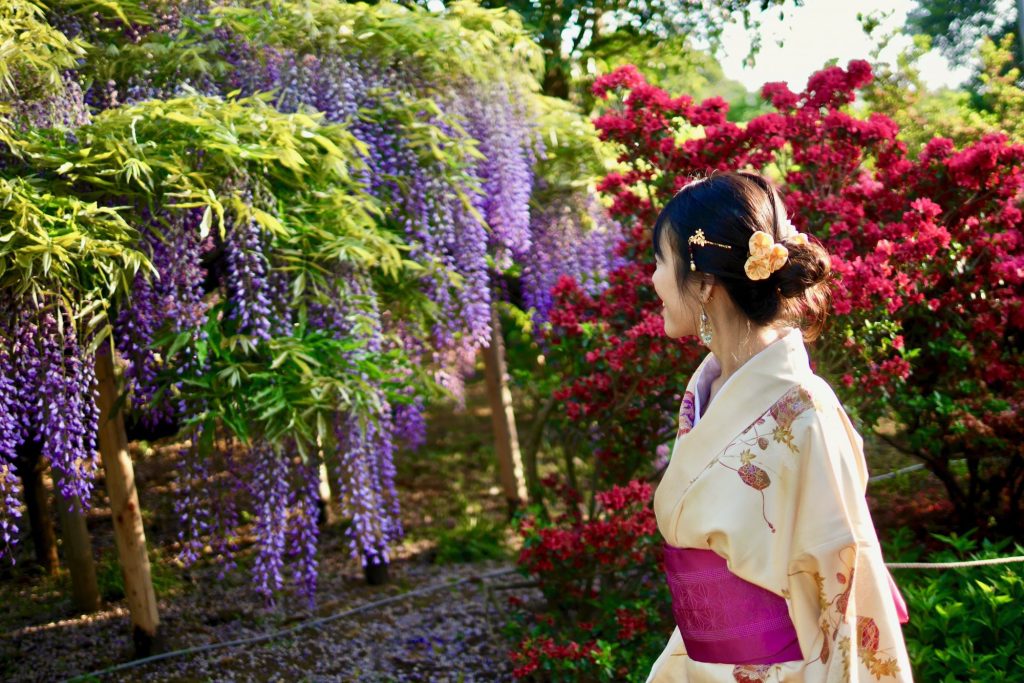
The truth is, no one knows exactly how, when, where and why. There are many theories floating around, in books, on the Internet and in traditional and modern media alike. Some say, the kanzashi happened as long ago as the Jōmon period in Japan, facing decline and rise in trend across the Heian and Edo periods.
Such is the kanzashi’s humble origin, as I imagine it starting out as nothing more than a convenient, easily-obtainable and sustainable way to keep hair out of one’s face and eyes. Then, it gained prominence along the way, eventually having a kanji character (簪-kanzashi) assigned to it.
Women in the Heian period wore their hair down their backs freely, a style as we would call it now drooping hair (垂髪-taregami), resulting in kanzashi falling obsolete for that long period of time.
By the Edo period, when women were allowed more freedom and fun in their fashion and hair-styling, not only did the kanzashi come back full force in style, they came in various newer forms.
Did the women change their hairstyles to match the kanzashi? Or did the kanzashi evolve to keep up with the women’s increasingly chic tastes? That makes a lovely question to be answered another day.